
Quick answer
Block the Facebook app and facebook.com together, add Messenger if that's part of the habit, and lock the block. On Android, Sunnah Lock does this with a PIN and Lockdown Mode. On iPhone, Sunnah Lock blocks the app and the website, enforced by iOS itself. You keep your account, photos and groups. You just stop opening it on autopilot.
Facebook is the one people feel a bit silly about. It's not the shiny new app. It's just the thing you open while the kettle boils, and then again in bed, and then again at a red light.
The good news: Facebook is the most studied app on this list, and the studies are encouraging. Here's what they found, and how to block it.
What happens when people actually quit Facebook?
Economists have tested this properly, with randomised experiments. Here's what they found.
The first experiment was published in the American Economic Review. Researchers had people deactivate Facebook for the four weeks before the 2018 US midterm election. Deactivation "reduced online activity, while increasing offline activities such as watching TV alone and socializing with family and friends." It "increased subjective well-being." And here's the part that matters for you: it "caused a large persistent reduction in post-experiment Facebook use."1
In other words, a few weeks away broke the habit. Once people were out of the loop, plenty of them didn't go back to the old amount.
The second experiment, written up by the National Bureau of Economic Research, went bigger. People who deactivated Facebook for six weeks before the 2020 election saw a 0.060 standard deviation improvement in an index of happiness, depression and anxiety. That's a small effect, the kind you notice as "I feel a bit better" rather than a life transformation. And it was concentrated among users over 35.2
That's worth sitting with. Teens have mostly moved on from Facebook: only 20% of US teens use it daily.3 The people it's quietly weighing on are adults.
Why a block beats deleting your account
Deleting Facebook is a big, permanent decision. You lose photos, groups, marketplace chats and contacts you'd have no other way to reach. Most people never do it, so they end up doing nothing.
A block is the middle path, and it's closer to what the experiments tested: stepping away for weeks, not burning it down. Keep the account. Block the app so opening it stops being a reflex. If you need it for a group or an event, set a Usage limit of 15 minutes a day instead of blocking it outright.
What Facebook gives you built in
Facebook has a tool called Your Time on Facebook, which lets you "see how much time you spend on Facebook and manage your time."5 You can set a daily reminder for when you hit the amount of time you want to spend.
The catch is in Meta's own announcement: "You can change or cancel the reminder at any time."4 So when the reminder pops up and you're mid-scroll, you tap it away.
For under-18s, things are changing. In August 2026, Meta agreed in a settlement with a group of US state attorneys general to a 2-hour daily limit across Facebook and Instagram combined, which teens can't turn off without a parent. It applies in participating US states and is pending judicial approval.6 Adults get nothing like it.
The loopholes that break most Facebook blocks
facebook.com. Block the app and the website is still one tap away in your browser.
The other Facebook apps. Messenger is a separate app, and so is Facebook Lite on Android. If the habit is scrolling, block Facebook. If the habit is chatting too, add Messenger.
The reminder. Anything you can cancel "at any time," you will, usually at the exact moment you meant to stop.
How to block Facebook on Android
- Get Sunnah Lock from Google Play.
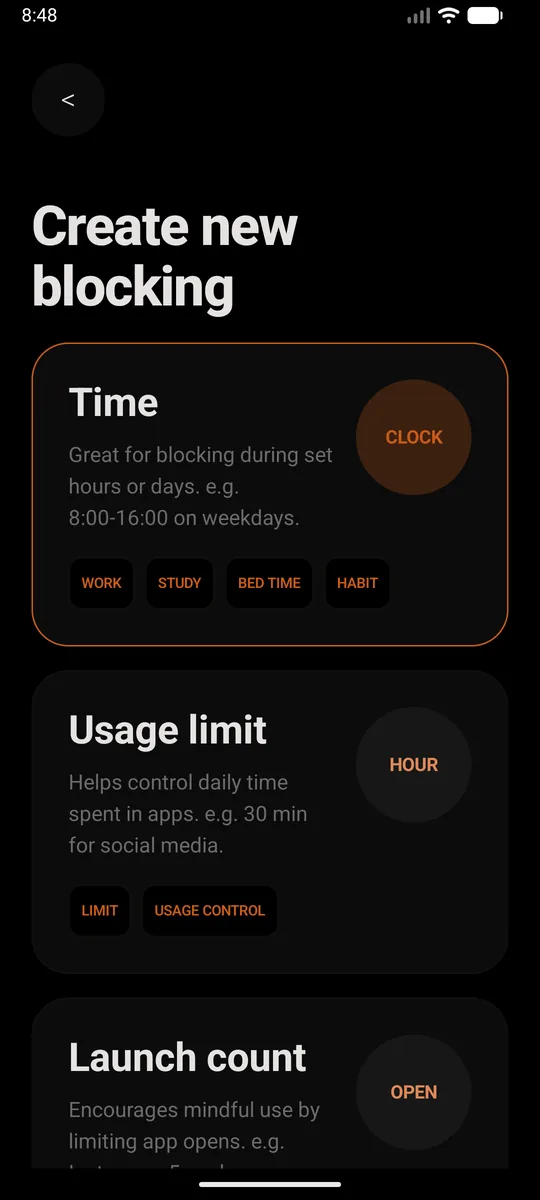
- Create a new block. Pick Time if you want Facebook gone during set hours, like school nights or bedtime. Pick Usage limit if you'd rather allow a little each day, say 30 minutes. Or just set it to all day, every day.
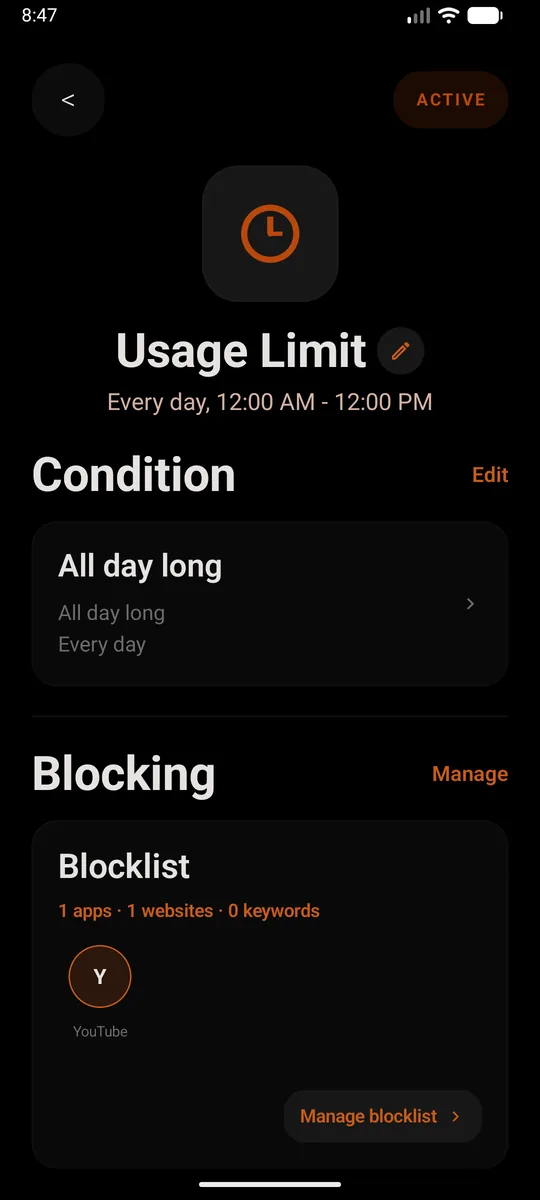
- Add Facebook to the blocklist. Add the app, then add
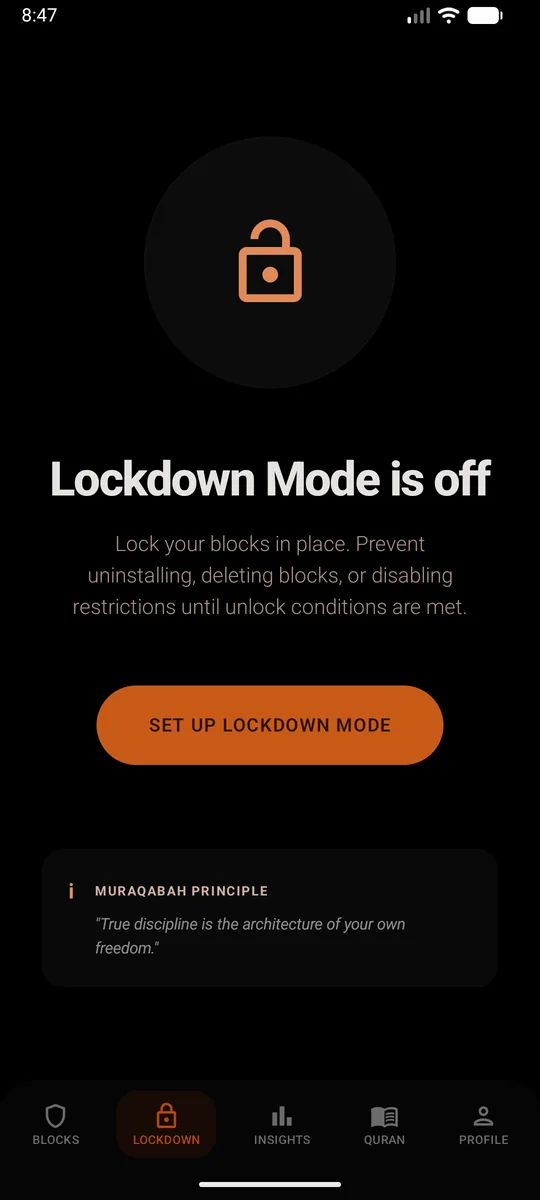
facebook.comas a website too. Skip that second part and the browser becomes the back door. From then on, opening Facebook closes it straight away and shows a reminder instead. - Set a PIN and turn on Lockdown Mode. This is the bit that makes it stick. Lockdown Mode stops the block being deleted, the restrictions being switched off, or Sunnah Lock being uninstalled until your unlock conditions are met.
Without installing anything
Digital Wellbeing can put a timer on Facebook: Settings, Digital Wellbeing, App timers. When the timer ends, "the app closes and its icon dims."7 You can go back into Settings and change it whenever you like, which is exactly the problem.
How to block Facebook on iPhone
- Get Sunnah Lock from the App Store.
- Build a block. Start from a ready-made template like Night or Home, or build your own from scratch.
- Add Facebook to it, and put
facebook.comon your website list. That covers the app and the site, so Safari doesn't turn into the back door. - Keep the adult content filter on. It's Apple's own filter, and the block is enforced by iOS itself, so it isn't a setting you can talk yourself out of at midnight.
Without installing anything
Screen Time can set a Time Allowance for Facebook. When it's up, Apple says "you can tap One More Minute or send a request for more time."8 On your own phone, you're the one who says yes.
Try the four-week version
The first study ran for four weeks. You can copy it. Block Facebook all day, every day, for four weeks, with Lockdown Mode on so you can't cave on day three. After four weeks, turn it back into a 15-minute Usage limit and see if you even want the time.
If Instagram is where the scroll moves to, it's the same company and the same feed. See how to block Instagram.
Questions people ask
How do I block Facebook on my phone?
Block the Facebook app and facebook.com together, then lock the block. On Android, Sunnah Lock does both, with a PIN and Lockdown Mode so the block can't be removed. On iPhone, Sunnah Lock blocks the app and the website, enforced by iOS itself.
What happens when you stop using Facebook?
In a study published in the American Economic Review, people who deactivated Facebook for four weeks spent less time online, spent more time with family and friends, and reported higher well-being. They also kept using Facebook less after the experiment ended.
Does Facebook have a time limit setting?
Facebook has Your Time on Facebook, which shows how much time you spend and lets you set a daily reminder. Meta's own announcement says you can change or cancel the reminder at any time, so it's a nudge rather than a limit.
Is blocking Facebook better than deleting my account?
For most people, yes. Deleting an account is permanent and you lose photos, groups and contacts. A block keeps the account but takes away the reflex to open it, and you can set it for certain hours instead of forever.
Who benefits most from taking a break from Facebook?
In a large deactivation experiment written up by the National Bureau of Economic Research, the well-being benefit from quitting Facebook for six weeks was concentrated among users over 35.
Does blocking the Facebook app also block Messenger?
Not automatically. Messenger is its own app. If you want both gone, add Messenger to the same block as Facebook.
Make the block actually hold
On Android, Sunnah Lock blocks apps, websites and keywords, with PIN-protected settings and Lockdown Mode to keep it in place. On iPhone it blocks apps, websites and whole categories, enforced by iOS itself.
Block something else
Sources
- The Welfare Effects of Social Media American Economic Review, 2020
- The Effect of Deactivating Facebook and Instagram on Users' Emotional State National Bureau of Economic Research
- Teens, Social Media and Technology 2024 Pew Research Center, December 2024
- New Tools to Manage Your Time on Facebook and Instagram Meta, August 2018
- Your Time on Facebook Facebook Help Center
- Meta settlement sparks social media changes for teens: What parents need to know ABC News, August 2026
- Manage how you spend time on your Android phone with Digital Wellbeing Android Help
- Family Sharing and parental controls overview for kids and teens Apple Support, September 2026